
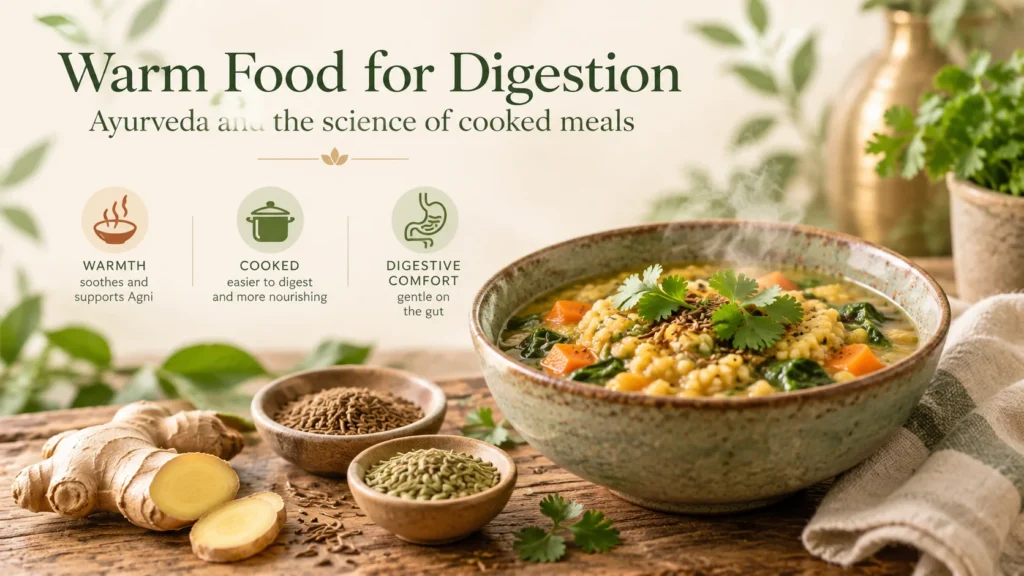
Warm food for digestion has been recommended in Ayurveda for centuries. Traditional Ayurvedic nutrition favours freshly cooked meals because they are considered supportive of Agni, the body’s digestive and transformative capacity.
Modern food science also provides practical reasons for choosing cooked meals. Heat and moisture can soften ingredients, change starch structure and make certain foods easier for digestive enzymes to break down.
🔥 Why Warm Food for Digestion Matters in Ayurveda
Ayurveda considers digestion central to everyday wellbeing.
The traditional concept of Agni, often translated as digestive fire, describes the body’s capacity to process and transform food.
Warm, moist dishes such as soups, stews, porridge and cooked vegetables are traditionally regarded as supportive of Agni, particularly when digestion is considered sluggish or irregular.
Ayurvedic dietary principles also consider the individual’s constitution.
For example, Vata is associated with cold and dry qualities, making warm, moisture-rich meals a common traditional recommendation.
Kapha is associated with coldness and heaviness, so lighter, warming preparations are often preferred.
These recommendations belong to traditional Ayurvedic theory rather than medically established digestive classifications.
Learn more in our Ayurvedic Principles Explained guide.
🥣 The Science Behind Warming Foods
The benefits of cooking warm foods for better digestion are particularly interesting when we examine starch-rich foods and vegetables.
When rice, potatoes or grains are cooked with water, their starch granules absorb moisture and swell.
This process, known as starch gelatinisation, changes the structure of starch and generally makes it more accessible to digestive enzymes.
Cooking also softens many plant tissues, reducing the effort needed to chew certain foods.
For people who find large portions of raw vegetables uncomfortable, gently cooked alternatives may be easier to tolerate.
A scientific review on starch gelatinisation and digestibility examines how heat and moisture change starch structure.
Importantly, these benefits arise mainly from cooking and preparation, not simply from serving food at a high temperature.
🌡️ Does the Temperature of Food Affect Digestion?
Meal temperature can influence some digestive processes.
A small human study investigated how meals served at different temperatures affected gastric emptying — the movement of food from the stomach into the small intestine.
Researchers observed differences in early gastric emptying measurements, although overall half-emptying times were not significantly different.
Read the human study on PubMed.
This research suggests that food temperature can affect certain digestive measurements. It does not establish that hotter meals consistently improve digestion.
The more practical considerations are how food is prepared, its texture, nutritional composition and individual tolerance.
🌿 Five Ways to Include Them
Adding warm food for digestion to your daily routine doesn’t require complicated recipes.
- Porridge: Cook oats with milk or water and add fruit or cinnamon.
- Vegetable soups: Simmer vegetables until tender and add lentils for a more substantial meal.
- Rice dishes: Combine freshly cooked rice with vegetables and your preferred protein.
- Slow-cooked stews: Use gentle cooking and moisture to soften meat, pulses and vegetables.
- Warming spices: Ginger, cumin and fennel add flavour and are traditionally valued in Ayurvedic cooking.
These dishes provide practical examples of how warm food for digestion can fit into a balanced diet.
There’s no need to eliminate raw vegetables, salads or cold foods if you enjoy and tolerate them comfortably.
🌱 Making Food for Digestion Part of Everyday Life
Ayurveda’s preference for freshly cooked meals reflects its traditional understanding of Agni, food qualities and individual constitution.
Modern food science provides support for several practical aspects of this approach. Cooking can soften food, alter starch structure and improve the accessibility of certain nutrients during digestion.
For some people, warm soups, porridge and other moisture-rich dishes may also be more comfortable and enjoyable than large portions of raw or dry foods.
The takeaway: Choosing warm food for digestion is a practical way to enjoy nourishing, well-prepared meals. Ayurveda provides the traditional reasoning, while modern science helps explain how cooking changes the foods we eat.