
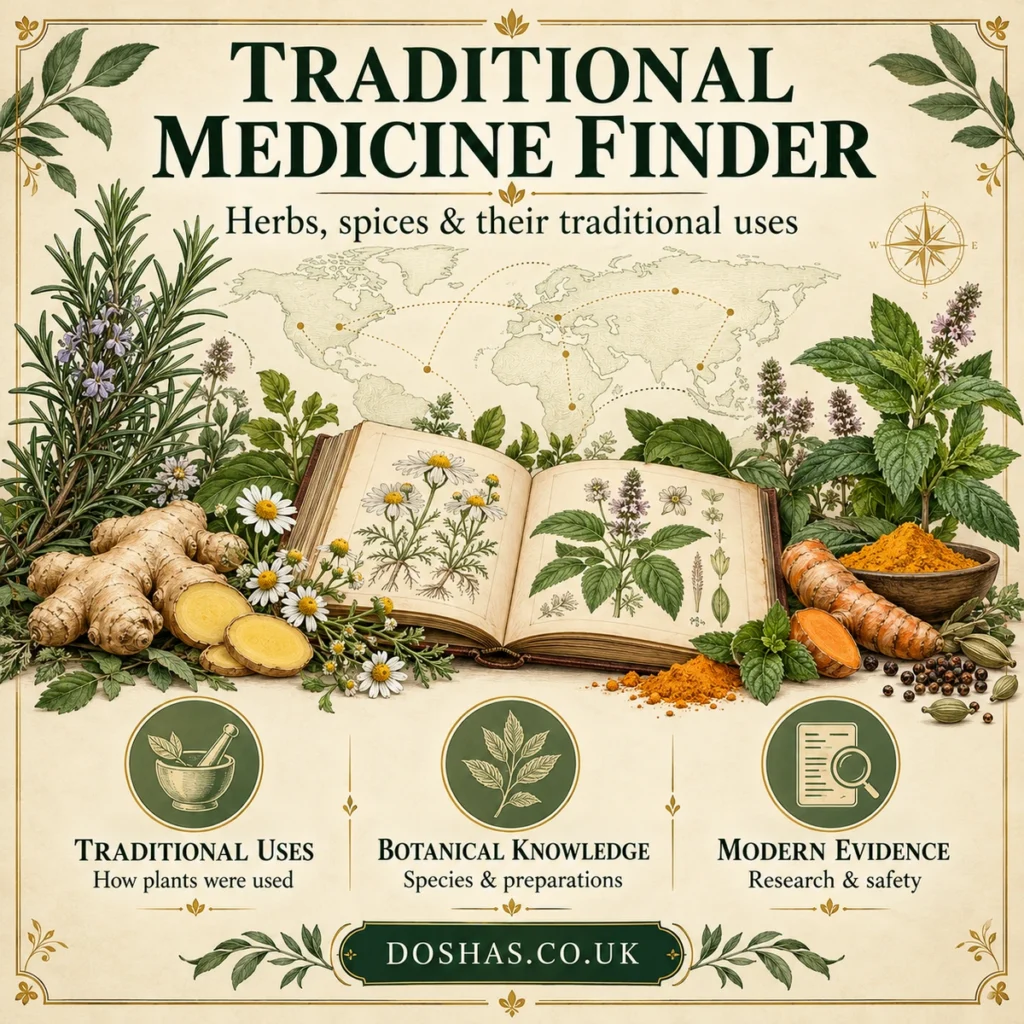
Our Traditional Medicine Finder explores how herbs, spices and medicinal plants have been used across traditional healing systems for generations.
From Ayurveda and Traditional Chinese Medicine to European herbalism and Indigenous healing traditions, plants have played an important role in how different cultures approached health.
But what were these plants actually used for? Why were certain herbs valued for digestion, sleep or other health concerns? And what does modern research tell us about their properties?
Our aim is to bring that knowledge together in one accessible place, with clear explanations of traditional uses, potential benefits and available scientific evidence.
🔎 Search Traditional Medicinal Herbs and Spices
Use our Traditional Medicine Finder to search for a herb, spice or medicinal plant by name.
Whether you’re interested in familiar kitchen ingredients or plants associated with traditional herbal remedies, the finder is designed to help you understand their historical uses.
Search for a herb or spice below.
[Place the Traditional Medicine Finder search tool here]
🌍 Traditional Healing Knowledge From Around the World
Medicinal plants have been used across many cultures, often with different preparations and explanations for their effects.
Our Traditional Medicine Finder brings together documented knowledge from traditions including:
- Ayurveda: The ancient Indian system that considers diet, herbs, digestion and individual constitution when addressing health.
- Traditional Chinese Medicine: A system incorporating herbal formulations and traditional concepts of balance and bodily function.
- European Herbal Medicine: Centuries of recorded botanical remedies, including herbal teas, infusions and medicinal preparations.
- Indigenous and Folk Medicine: Plant knowledge developed and passed down within different communities, often closely connected to local environments.
In Ayurveda, the traditional understanding of health includes the three doshas: Vata, Pitta and Kapha.
These principles help explain how Ayurveda traditionally interprets individual constitution and balance. They are not required to use our herbal search tool.
Different traditions may use the same plant for different purposes. Those distinctions are worth understanding rather than treating every historical use as identical.
🌱 What Were Medicinal Herbs Traditionally Used For?
Throughout history, plants have been prepared as teas, decoctions, powders, poultices and herbal extracts.
Some familiar examples include:
- Ginger: Traditionally used in Ayurveda and other Asian medical systems for digestive complaints and nausea.
- Chamomile: Used in European herbal traditions for mild digestive discomfort and relaxation.
- Peppermint: Traditionally prepared for digestive complaints, including bloating and abdominal discomfort.
- Turmeric: Valued in Ayurveda for various traditional applications, including digestive and skin preparations.
- Rosemary: Used in European herbal medicine for digestive complaints and traditionally associated with memory.
These examples describe historical uses, not guaranteed medical benefits.
Our Traditional Medicine Finder is intended to explain those distinctions while exploring what is currently known about each plant.
🔬 Traditional Uses and Modern Scientific Evidence
Understanding historical herbal practices is one part of the picture.
Modern researchers also investigate the naturally occurring compounds found in medicinal plants.
For example, scientists examine essential oils, polyphenols, alkaloids and other constituents to understand how they interact with biological processes.
Some compounds influence enzymes, receptors or cellular signalling pathways. However, laboratory activity does not necessarily mean a herbal preparation produces the same effect in humans.
A relevant 2024 research review, The Role of Indigenous Knowledge in Advancing the Therapeutic Use of Medicinal Plants: Challenges and Opportunities, examines how traditional plant knowledge contributes to medicinal research.
The authors discuss the value of knowledge passed through generations and the challenges of connecting traditional applications with scientific investigation.
The paper helps explain why documenting traditional uses matters, although it does not establish the effectiveness of every plant discussed.
Research findings also depend on the plant species, preparation, dosage and quality of the evidence.
Our Traditional Medicine Finder aims to distinguish documented traditional uses from benefits supported by modern clinical research.
📖 Why Botanical Names and Preparation Methods Matter
A plant’s common name does not always identify its species accurately.
Different species can share similar names while containing different chemical constituents.
Preparation matters too.
A herbal infusion, dried powder and concentrated extract may contain very different amounts of active compounds.
For this reason, the Traditional Medicine Finder will identify botanical species and explain relevant preparation differences wherever reliable information is available.
We also recognise that natural does not automatically mean safe. Some medicinal plants can cause adverse effects or interact with prescribed medicines.
🌿 Respecting Ancient Knowledge Without Inventing Answers
Traditional herbal medicine represents an extensive body of knowledge developed across different cultures and generations.
However, not every historical claim has been tested in clinical trials, and not every medicinal plant has sufficient research to establish its effectiveness.
Our Traditional Medicine Finder follows a straightforward principle:
If reliable information is unavailable, we say so.
We believe traditional knowledge deserves respect, but explanations must remain accurate about what is documented, what research suggests and what remains uncertain.
❓ Frequently Asked Questions
What is traditional herbal medicine?
Traditional herbal medicine involves the use of plants and plant preparations within established cultural healing practices.
These may include Ayurvedic medicine, Chinese herbal medicine, European herbalism and other documented traditions.
Are traditional medicinal herbs scientifically proven to work?
Some herbal preparations have supporting clinical evidence for particular uses. Others have mainly historical, observational or laboratory evidence.
Effectiveness and safety must be assessed individually rather than assuming all traditional remedies work in the same way.
Can everyday herbs and spices have medicinal properties?
Many culinary herbs and spices contain biologically active compounds.
However, the amount consumed in food may be considerably lower than the doses investigated in medicinal research.
Does the finder only cover Ayurveda?
No. Although Doshas is rooted in Ayurvedic education, the Traditional Medicine Finder explores documented plant uses from different medical traditions worldwide.
🌿 Explore the Knowledge Behind Medicinal Plants
The history of herbal medicine extends far beyond any single culture or medical system.
By examining traditional uses alongside botanical knowledge and scientific research, we can develop a clearer understanding of why particular plants have been valued throughout history.
Whether you’re interested in Ayurvedic herbs, European herbal remedies or the medicinal plants of other cultures, our aim is to make that information accessible, informative and honest.
Historical uses are not proof of effectiveness or personal treatment advice. Check safety and interactions before medicinal use.