
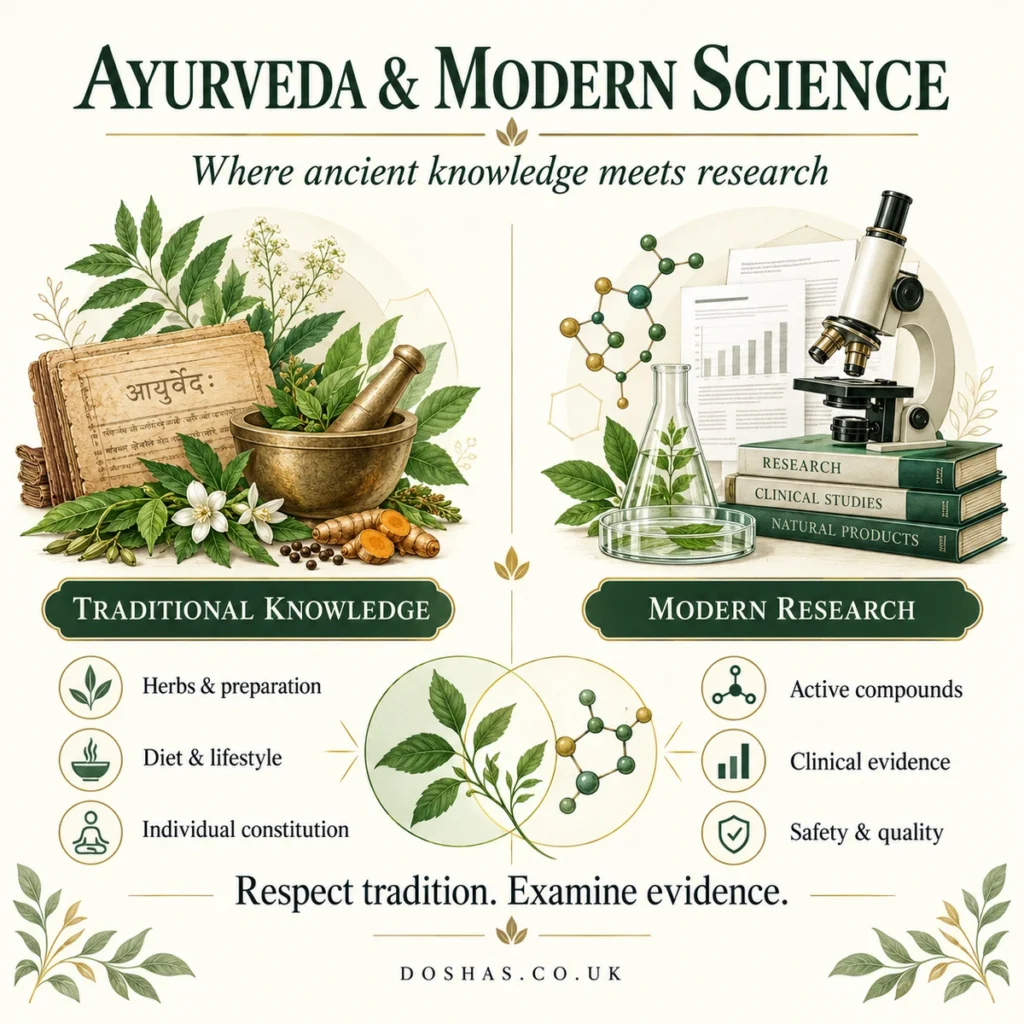
The relationship between Ayurveda and modern science is particularly interesting because both seek to understand human health, although they approach the subject differently.
Ayurveda has been practised for thousands of years, yet many of its traditional principles are now attracting the attention of modern researchers.
One developed through centuries of observation, experience and traditional practice. The other uses laboratory investigation, clinical trials and measurable biological processes.
Rather than viewing them as opposing systems, we can examine what each contributes to our understanding of health.
🌿 Understanding the Traditional Foundations of Ayurveda
Ayurveda originated in ancient India and developed a detailed approach to health based on diet, lifestyle, digestion, individual constitution and the relationship between the body and its environment.
Central to this system are the three doshas:
- Vata – Associated with movement, circulation, breathing and nervous activity within traditional Ayurvedic theory.
- Pitta – Associated with digestion, transformation, heat and metabolism.
- Kapha – Associated with structure, stability, lubrication and nourishment.
These are traditional functional principles, rather than anatomical structures or scientifically established biological systems.
Understanding Ayurveda and modern science begins with recognising this distinction.
Ayurveda traditionally considers the individual, their constitution, environment and daily habits when recommending dietary or lifestyle adjustments.
🔬 Where Ancient Knowledge Meets Scientific Investigation
Modern research allows us to investigate some of the biological processes that may help explain traditional Ayurvedic practices.
For example, medicinal plants contain naturally occurring compounds that can interact with enzymes, receptors and cellular signalling pathways.
Researchers can examine whether these interactions influence measurable outcomes such as inflammatory markers, digestive function or stress responses.
This is where Ayurveda and modern science can complement one another.
Traditional knowledge identifies practices and plants considered valuable through historical experience. Scientific investigation can then explore their active compounds, potential mechanisms, effectiveness and safety.
However, identifying a biological effect in laboratory research does not automatically establish a clinical benefit in humans.
📚 What Does the Scientific Evidence Actually Tell Us?
Research into Ayurvedic medicine has expanded considerably, but the quality and strength of evidence vary between treatments.
A particularly relevant paper is Bridging Ayurveda with Evidence-Based Scientific Approaches in Medicine, published in 2014.
The author examined how traditional Ayurvedic knowledge could be investigated through modern evidence-based methods, including the challenges of evaluating individualised treatments.
The paper argues for combining rigorous scientific investigation with research methods that properly account for Ayurveda’s traditional principles.
It is a discussion of research methodology, not a clinical trial proving that Ayurvedic treatments work.
This distinction is essential when discussing Ayurveda and modern science. Evidence must be assessed according to what a study actually investigated and demonstrated.
🧪 Why Studying Ayurveda Presents Challenges
Traditional Ayurvedic treatment is often individualised.
Two people experiencing similar symptoms may receive different recommendations depending on their constitution, digestion, lifestyle and perceived dosha imbalance.
Modern clinical trials commonly investigate standardised interventions, with participants receiving carefully controlled treatments.
This creates difficulties when researching an entire traditional medical system.
Nevertheless, Ayurveda and modern science can work together through carefully designed clinical trials, observational research and investigations into individual medicinal plants.
Researchers must also consider botanical identification, preparation methods, dosage and product quality.
These factors can substantially influence the chemical composition and safety of herbal preparations.
⚖️ Does a Lack of Research Mean Ayurveda Is Ineffective?
Not necessarily.
An absence of high-quality clinical evidence means a particular treatment has not been adequately established through that type of investigation.
It does not automatically prove that the treatment works or that it is ineffective.
This is an important consideration when examining Ayurveda and modern science.
Traditional knowledge provides valuable historical information and potential directions for investigation. Modern evidence helps determine whether specific interventions produce reliable benefits and whether their risks are acceptable.
Both deserve honest consideration.
🤝 Bringing Traditional Knowledge and Modern Evidence Together
As an Ayurveda herbalist and nutrition practitioner, I believe traditional knowledge deserves serious examination, while health recommendations should remain proportionate to the available evidence.
There is value in understanding why a herb was traditionally prescribed, how it was prepared and what modern research tells us about its chemical constituents.
The relationship between Ayurveda and modern science should encourage informed discussion, not competition between two different approaches.
Traditional Ayurvedic concepts should retain their original meaning rather than being presented as established modern physiological facts.
Equally, scientific findings should be explained accurately without overstating their significance.
📖 What You Can Expect From Our Research & Evidence Articles
Through this category, we will examine Ayurveda and modern science by exploring:
- Traditional Ayurvedic uses of medicinal plants.
- Active botanical compounds and their biological mechanisms.
- Clinical research and its limitations.
- Differences between traditional preparations and modern extracts.
- Safety considerations and the quality of available evidence.
Our aim is straightforward: to respect the knowledge preserved through Ayurveda while examining what modern research can genuinely tell us.
Ancient knowledge provides the foundations. Scientific investigation offers further understanding.
Together, they give us more to consider than either approach alone.