
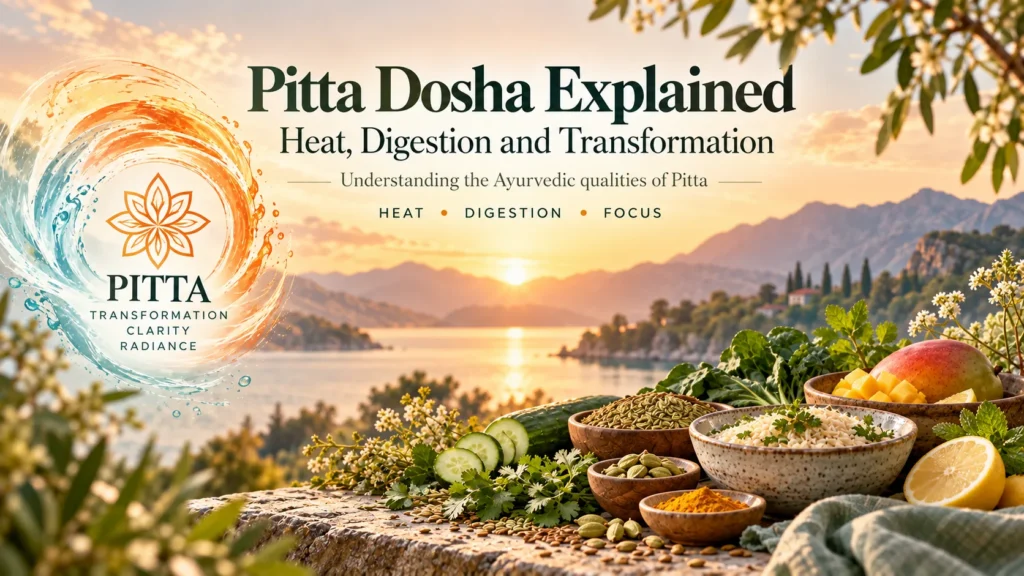
Pitta dosha is one of Ayurveda’s three fundamental constitutional principles. Associated with fire and water, Pitta traditionally represents heat, transformation, digestion and metabolic activity.
In Ayurvedic theory, someone with a predominantly Pitta constitution may have a strong appetite, a focused temperament and greater sensitivity to heat.
Understanding Pitta means looking at its traditional qualities, how those qualities influence Ayurvedic food recommendations and what modern research can genuinely tell us.
🔥 Pitta Dosha Explained – Fire and Transformation
Ayurveda describes five elements: earth, water, fire, air and space.
Pitta combines fire and water. Fire represents transformation, while water contributes the fluid qualities associated with Pitta.
These elements are traditional philosophical concepts, not literal descriptions of the body’s chemical composition.
The Main Qualities of Pitta
Ayurveda uses the term Guna to describe qualities associated with the doshas, foods and environments.
| Pitta quality | Traditional meaning |
|---|---|
| Hot | Warmth and heating qualities |
| Sharp | Intensity and penetrating action |
| Light | Relative lightness |
| Slightly oily | A degree of moisture or oiliness |
| Spreading | The tendency to disperse |
| Liquid | Fluidity and flow |
The principle of Samanya Vishesha explains that similar qualities tend to increase one another, while opposing qualities are traditionally used to encourage balance.
This is why Ayurvedic dietary guidance for Pitta often emphasises milder foods, moderation with pungent spices and avoiding excessive heat.
🌿 What Are the Characteristics of Pitta Dosha?
People traditionally described as Pitta-dominant may display several recognisable characteristics.
These include:
- A medium or athletic body frame.
- A naturally strong or regular appetite.
- Greater sensitivity to hot weather.
- A tendency towards feeling warm.
- A focused, organised and determined temperament.
- A preference for regular meals.
- Skin that may be sensitive or prone to redness.
These characteristics describe traditional Ayurvedic constitutional patterns.
They do not establish someone’s metabolic rate, hormonal profile or likelihood of developing a medical condition.
Ayurveda also recognises mixed constitutions, including Vata-Pitta and Pitta-Kapha.
⚖️ What Is Pitta Imbalance in Ayurveda?
Ayurveda distinguishes between Prakriti, a person’s underlying constitution, and Vikriti, their current state.
A predominantly Pitta constitution does not automatically mean that Pitta is excessive.
In traditional practice, increased Pitta qualities may be associated with excessive heat, irritability, strong hunger, a burning sensation or sensitivity to heavily spiced foods.
However, symptoms such as heartburn, digestive pain or persistent skin redness can have identifiable medical causes.
They should not be explained away as a Pitta imbalance.
Traditional Pitta-balancing approaches generally emphasise moderation, regular routines, milder meals and avoiding excessive environmental heat.
🥗 Pitta Dosha and Digestion
Digestion is particularly important in the traditional understanding of Pitta.
Ayurveda uses the term Agni to describe digestive and transformative capacity.
A sharp or intense form of Agni, known as Tikshna Agni, is traditionally associated with increased Pitta.
Within Ayurvedic theory, this may be described through strong hunger, rapid digestion or discomfort when meals are delayed.
How Digestion Actually Works
Modern physiology explains digestion through several coordinated processes.
The stomach releases hydrochloric acid, which creates the acidic environment needed to activate pepsin, an enzyme that begins breaking down proteins.
The pancreas releases digestive enzymes into the small intestine, where carbohydrates, fats and proteins are broken down into smaller components that can be absorbed.
Hormones, nerve signals and intestinal movement help regulate these processes.
Although Ayurveda associates Pitta with digestion and transformation, Pitta is not scientifically established as the equivalent of stomach acid, pancreatic enzymes or metabolic rate.
🌶️ Why Does Ayurveda Associate Pitta With Heating Foods?
Ayurveda classifies foods according to their traditional qualities, including taste, heating or cooling potency and preparation.
Three relevant principles are:
- Rasa: The six tastes — sweet, sour, salty, pungent, bitter and astringent.
- Virya: The traditionally described heating or cooling potency of a substance.
- Guna: Its qualities, such as heavy, light, dry, oily, hot or cold.
Pungent, sour and salty tastes are traditionally regarded as tending to increase Pitta when consumed excessively.
Sweet, bitter and astringent tastes are generally regarded as more balancing.
These are Ayurvedic classifications, not established measurements of how foods affect body temperature or inflammation.
What Makes Chilli Feel Hot?
Chilli provides a useful example of the difference between Ayurvedic tradition and modern physiology.
Chilli peppers contain capsaicin, the compound responsible for much of their characteristic burning sensation.
Capsaicin activates TRPV1 receptors, which are proteins found on sensory nerve cells. These receptors respond to potentially harmful heat and certain chemical stimuli.
When capsaicin activates them, nerve signals create a sensation of heat or burning even though the chilli has not necessarily raised the temperature of the surrounding tissue.
A research review examining how capsaicin activates TRPV1 receptors explains the molecular interactions involved in this process, drawing on structural and laboratory studies.
This provides a scientific explanation for chilli’s pungency. It does not prove that chilli increases Pitta as a measurable biological property.
🥒 What Foods Are Traditionally Recommended for Pitta?
A traditional Pitta diet generally favours milder preparations and foods described as cooling.
The emphasis is on moderation rather than eliminating entire food groups.
| Traditionally favoured | Traditionally moderated |
|---|---|
| Cucumber and courgette | Very hot chilli sauces |
| Leafy vegetables | Excessively pungent preparations |
| Sweet fruits | Strongly sour foods |
| Rice and other suitable grains | Very heavily salted foods |
| Mildly seasoned meals | Excessive amounts of heating spices |
Food temperature and Ayurvedic heating potency are not necessarily the same thing.
A food can be served warm while still being traditionally classified as cooling.
Likewise, a chilled food is not automatically considered suitable for everyone with a Pitta constitution.
Does Someone With Pitta Need to Avoid Spices?
Not necessarily.
Ayurveda considers the quantity, combination and preparation of spices rather than placing every ingredient on a strict blacklist.
Coriander, fennel and cardamom commonly appear in milder Ayurvedic preparations.
Chilli and other strongly pungent spices are traditionally moderated when Pitta qualities are considered excessive.
From a nutritional perspective, individual tolerance matters more than assigning someone a fixed dosha-based restriction.
Spices can contribute flavour and beneficial plant compounds, but they should not be treated as medicines simply because Ayurveda describes them as balancing.
🌱 Pitta Dosha and Skin Characteristics
Traditional descriptions of Pitta frequently include warm, sensitive or reddish skin.
Ayurvedic theory associates these characteristics with the qualities of heat and sharpness.
Modern dermatology explains skin redness through processes such as dilation of superficial blood vessels, inflammatory signalling, skin-barrier changes and environmental exposure.
These mechanisms do not demonstrate that a person has excessive Pitta.
Persistent redness, unexplained rashes or inflammation should be assessed according to their actual causes rather than constitutional assumptions.
🧘 Traditional Lifestyle Principles for Pitta Balance
Ayurveda considers daily habits alongside food choices.
Pitta-balancing routines traditionally aim to moderate intensity and encourage regularity.
Avoiding Excessive Heat
Taking breaks from strong sunshine, maintaining suitable hydration and avoiding prolonged overheating are practical measures.
The body regulates temperature through mechanisms including sweating and changes in blood flow to the skin.
These established physiological responses are separate from Ayurvedic explanations of Pitta.
Balanced Physical Activity
Ayurvedic guidance commonly favours moderate activity when Pitta qualities are considered excessive.
Walking, swimming and gentle yoga may provide alternatives to highly strenuous exercise.
Exercise intensity should depend on fitness, health and personal preference rather than dosha classification alone.
Regular Meals and Rest
Maintaining consistent eating and sleeping habits is another traditional recommendation.
Regular sleep supports circadian rhythms, while an appropriate eating pattern helps meet individual energy and nutritional requirements.
Neither practice has been demonstrated to reduce a measurable Pitta level, but both can form part of a sensible daily routine.
🔬 What Does Scientific Research Say About Pitta Dosha?
Pitta is a recognised concept within traditional Ayurveda, but determining whether someone has a biologically distinct Pitta constitution remains an area of investigation.
A 2025 review published in Frontiers in Medicine examined 94 studies investigating methods used to assess Ayurvedic constitution, known as Prakriti.
Researchers identified 64 different assessment tools, including questionnaires and computer-assisted methods.
Only 20 had undergone some form of validation. Two met seven of nine recommended development and validation criteria, while important limitations remained.
The researchers highlighted gaps in reliability testing, scientific standardisation and assessment across different populations.
This matters because identifying someone as predominantly Pitta depends on whether traditional constitutional characteristics can be measured consistently.
The review did not establish Pitta as a distinct biological system or demonstrate that Pitta-specific diets prevent or treat disease.
Individual food ingredients can be researched using modern methods, but their scientifically established effects should not be confused with traditional dosha classifications.
✅ Discover Your Ayurvedic Dosha
Do you recognise some of the traditional Pitta characteristics described above?
Ayurveda considers everyone to possess a combination of Vata, Pitta and Kapha.
Our free 15-question quiz explores physical characteristics, appetite, digestion, sleep, energy and temperament.
The results show how your answers correspond to the three dosha classifications, with explanations of their traditional meanings.
This is an educational self-assessment rather than a medical diagnostic test.
📚 Explore the Three Doshas
Pitta is one part of Ayurveda’s wider constitutional framework.
Our Doshas Explained guide introduces the three doshas, their traditional elements and their relationship to food and lifestyle.
You can also explore Vata Dosha Explained to understand the contrasting qualities of movement, lightness and dryness.
For more articles exploring traditional Ayurvedic knowledge alongside scientific research, visit our Ayurveda Blog.
Understanding Pitta dosha means recognising how Ayurveda traditionally interprets heat, transformation and individual constitution, while keeping those explanations separate from established medical science.