
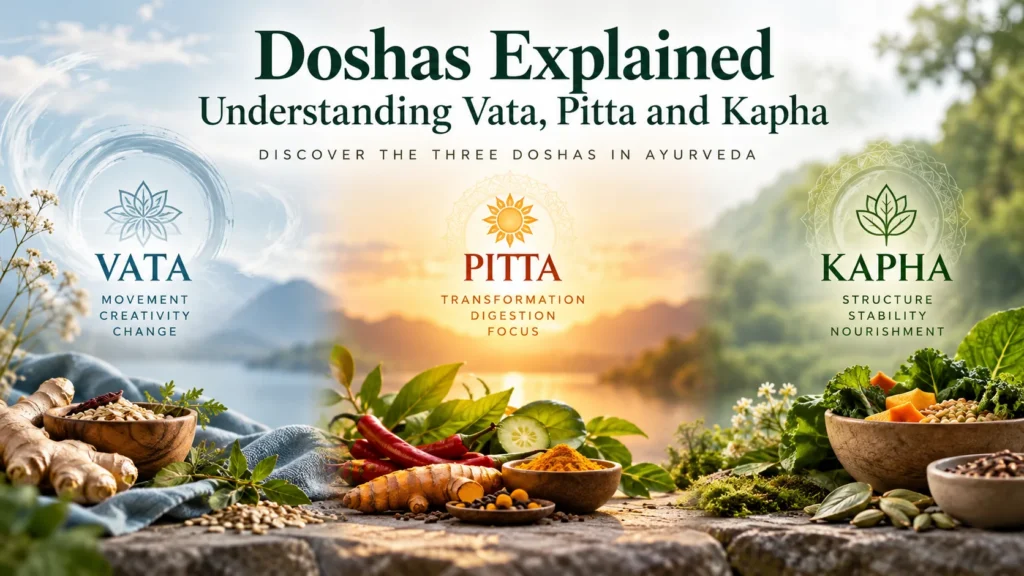
Doshas explained: Ayurveda describes three fundamental principles known as Vata, Pitta and Kapha. Together, they form a traditional framework for understanding individual constitution, digestion, food qualities and everyday habits.
Each dosha is associated with particular characteristics. Vata represents movement, Pitta transformation and Kapha structure and stability.
According to Ayurveda, everyone possesses all three doshas, although one or two may be more prominent in their natural constitution.
Understanding these differences is the starting point for learning how Ayurvedic food and lifestyle principles are traditionally applied.
🌿 The Three Doshas Explained – Vata, Pitta and Kapha
Ayurveda describes five elements: space, air, fire, water and earth. The three doshas represent different combinations of these elements.
| Dosha | Elements | Main traditional qualities |
|---|---|---|
| Vata | Air and space | Dry, light, cold, mobile |
| Pitta | Fire and water | Hot, sharp, slightly oily |
| Kapha | Earth and water | Heavy, cool, moist, stable |
These elements are part of traditional Ayurvedic philosophy, not literal measurements of the substances making up the body.
A central Ayurvedic principle is that similar qualities tend to increase one another, while opposing qualities are used to encourage balance.
For example, warm and moist foods are traditionally recommended when Vata’s cold and dry qualities are considered excessive.
🌬️ Vata Dosha Explained – Movement and Change
Vata is associated with air and space.
Within Ayurvedic theory, Vata governs movement, including breathing, physical activity and the movement of food through the digestive system.
Traditional Vata Characteristics
People described as Vata-dominant may display:
- A naturally lighter or slimmer build.
- Variable appetite and digestion.
- Quick thinking and creativity.
- Greater sensitivity to cold weather.
- Irregular sleep or energy patterns.
These descriptions are traditional constitutional characteristics rather than established medical findings.
Foods Traditionally Associated With Vata Balance
Because Vata is described as cold, light and dry, Ayurveda generally favours foods with opposing qualities.
Warm soups, cooked oats, stews, well-cooked rice and vegetables prepared with a little oil are common examples.
Cooking changes the physical characteristics of food. Heat softens plant cell walls and can gelatinise starch, making some foods easier to chew and digest.
However, these physiological effects do not establish that a person’s Vata has increased or decreased.
For a fuller explanation, see our forthcoming Vata Dosha Explained guide.
🔥 Pitta Dosha Explained – Heat and Transformation
Pitta is associated with fire and water.
In traditional Ayurveda, Pitta represents transformation and is particularly associated with digestion, appetite and heat.
Traditional Pitta Characteristics
Pitta-dominant individuals are traditionally described as having:
- A medium or athletic build.
- Strong or consistent appetite.
- A focused and determined temperament.
- Greater sensitivity to heat.
- A preference for regular meals.
Foods Traditionally Associated With Pitta Balance
Pitta is considered hot and sharp, so Ayurvedic dietary guidance generally favours milder foods and moderation with strongly heating ingredients.
Courgettes, cucumber, leafy vegetables, sweet fruits and gently seasoned meals are commonly included in traditional Pitta-balancing diets.
Highly pungent spices, including chilli, are often moderated within this approach.
The classification reflects traditional Ayurvedic food energetics. It does not mean everyone described as Pitta-dominant will react to these ingredients in the same way.
Our Pitta Dosha Explained guide will examine these principles in greater detail.
🌱 Kapha Dosha Explained – Structure and Stability
Kapha is associated with earth and water.
In Ayurveda, Kapha represents structure, stability, nourishment and lubrication.
Traditional Kapha Characteristics
People described as Kapha-dominant may exhibit:
- A naturally broader or sturdier frame.
- A calm, patient temperament.
- Steady energy and endurance.
- A preference for familiar routines.
- A tendency towards slower, more deliberate activity.
Foods Traditionally Associated With Kapha Balance
Kapha is traditionally described as heavy, cool, moist and stable.
Ayurvedic dietary guidance therefore tends to favour lighter, warming preparations, varied meals and regular physical activity.
Cooked vegetables, pulses, ginger, cumin and other culinary spices commonly feature in this approach.
These are traditional recommendations rather than evidence that Kapha represents a medically measurable metabolism or body type.
Our forthcoming Kapha Dosha Explained page will explore these characteristics and dietary principles further.
⚖️ Can You Have More Than One Dosha?
Yes. Ayurveda considers all three doshas to be present in everyone.
Some people are traditionally classified as having one dominant dosha, while others display a combination of two.
A constitution involving relatively balanced characteristics of all three doshas is sometimes described as Tridoshic.
These combinations form part of the traditional concept of Prakriti, which describes an individual’s natural constitution.
Ayurveda also distinguishes Prakriti from Vikriti, the individual’s current state of balance or imbalance.
For example, someone considered naturally Pitta-dominant may experience characteristics traditionally associated with increased Vata during a period of irregular eating or disrupted routines.
These distinctions are used within Ayurvedic practice, but they should not be mistaken for medically validated diagnostic categories.
🥗 How Do the Three Doshas Relate to Food?
Food classification is one of the most practical applications of traditional Ayurvedic theory.
Rather than examining nutrients alone, Ayurveda considers qualities such as warmth, moisture, heaviness, taste and preparation.
Three particularly relevant principles are:
- Guna: The qualities of a food, such as light, heavy, dry, oily, hot or cold.
- Rasa: The six traditional tastes — sweet, sour, salty, pungent, bitter and astringent.
- Virya: The heating or cooling potency traditionally attributed to an ingredient.
Ayurveda also uses the concept of Agni, traditionally associated with digestion and transformation.
Agni should not be treated as an exact equivalent of stomach acid, digestive enzymes or metabolic rate. These are distinct modern physiological processes.
Why the Whole Food Matters
Consider a meal containing rice, vegetables, ginger and several spices.
Ayurveda would traditionally consider the combined qualities of the ingredients, the cooking method and the individual consuming the meal.
A cooked vegetable stew, for example, may be classified differently from a cold raw salad containing similar ingredients.
That approach is central to the Ayurvedic Ingredient Scanner we’re developing for Doshas.co.uk.
The scanner will examine packaged food ingredient lists using traditional Ayurvedic classifications and explain how the combined formulation relates to Vata, Pitta and Kapha.
It is intended as an educational tool, not a medical assessment of food safety or individual nutritional requirements.
🔬 What Does Modern Research Say About the Three Doshas?
Traditional Ayurveda has been practised for centuries, but its constitutional classifications are not yet established as scientifically validated biological categories.
Researchers have investigated whether Prakriti questionnaires and other assessment methods can identify Ayurvedic constitutional characteristics reliably.
A 2025 review published in Frontiers in Medicine examined 94 studies of Ayurvedic constitutional assessment.
The researchers identified 64 different assessment tools. Only 20 had undergone some form of validation, and none fully met the review’s scientific evaluation criteria.
The authors identified limitations involving test reliability, validation methods and the diversity of populations studied.
This matters because a questionnaire identifying someone as predominantly Vata, Pitta or Kapha does not establish that they possess a distinct, scientifically measurable biological type.
Research into Ayurvedic constitutional assessment continues, but traditional theory and demonstrated clinical evidence must remain clearly distinguished.
🧘 Discover Your Dosha With Our Free Quiz
Now that we’ve explained the three doshas, you may be wondering which characteristics most closely match your own.
Our free 15-question dosha quiz explores physical characteristics, appetite, digestion, temperament, energy and sleep patterns.
Your results show the proportion of answers associated with Vata, Pitta and Kapha, accompanied by explanations of their traditional meanings.
The quiz is designed for education and self-reflection rather than medical diagnosis.
📚 Continue Learning About Ayurveda
Understanding Vata, Pitta and Kapha provides the foundation for exploring traditional Ayurvedic principles in greater depth.
Our forthcoming individual guides will examine each dosha separately, including its qualities, food classifications and traditional lifestyle recommendations.
You can also visit our Ayurveda Blog for articles on traditional ingredients, herbs, spices and emerging research.
To learn more about the qualifications and approach behind this website, visit About Doshas.
The three doshas provide a traditional way of interpreting individual differences. Understanding the theory, its practical applications and the limitations of the evidence is the best place to begin.