
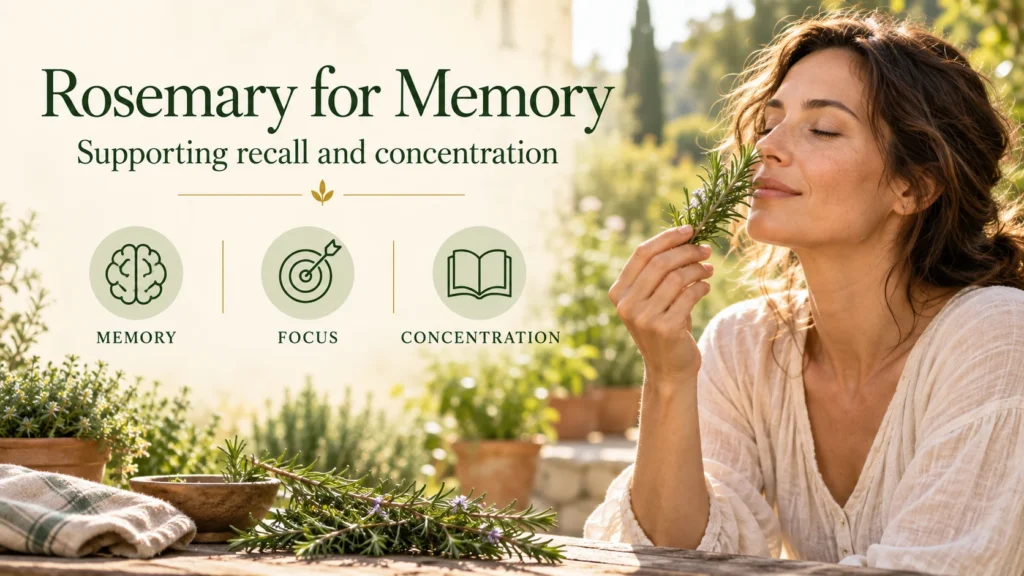
Rosemary for memory has a long history in herbal practice, with human research giving us useful reasons to value this familiar kitchen herb. Its natural compounds may influence attention, the retrieval of information and protective processes within brain cells.
As a practitioner, I look at the preparation, the amount used and the intended purpose. With rosemary, the evidence offers a particularly useful lesson: modest amounts deserve attention.
🧠 How rosemary for memory may work
One explanation for rosemary for memory involves acetylcholine, a chemical messenger that helps nerve cells communicate. It plays a role in directing attention, learning and forming memories.
After acetylcholine delivers its message, an enzyme called acetylcholinesterase breaks it down. Laboratory research suggests that some rosemary constituents, including 1,8-cineole, can slow this enzyme’s activity.
This provides a possible route through which rosemary could influence mental performance. Allowing acetylcholine to remain available for longer may affect communication between nerve cells, although this mechanism has not been confirmed in people using ordinary culinary amounts.
🔬 Rosemary for memory: what the human evidence shows
Research on rosemary for memory has examined both the speed of retrieving information and the ability to remember everyday tasks. These are different aspects of cognition—the mental processes involved in learning, thinking and remembering.
🌿 Memory speed in older adults
A 2012 randomised, placebo-controlled study involving 28 older adults compared four doses of dried rosemary leaf with placebo. Participants, whose average age was 75, completed computerised tests over the following six hours.
The 750 mg dose improved memory speed compared with placebo. This measured how quickly participants could retrieve information.
The highest dose, 6,000 mg, impaired memory speed. For anyone considering rosemary for memory, this is a practical finding: increasing the amount did not increase the benefit.
The trial supports a short-term effect at the lower dose. Larger studies would help establish how consistently that benefit occurs with regular use.
🌿 Everyday recall in younger adults
A separate 2018 randomised trial involved 68 university students. Participants took either 500 mg of rosemary twice daily or placebo for one month.
Those receiving rosemary reported improvements in remembering past information and remembering to carry out future tasks. Examples include recalling something previously learned or remembering a planned appointment.
This adds another useful dimension to rosemary for memory. The results concerned everyday experiences of remembering, measured through questionnaires rather than objective memory tests.
🛡️ Supporting the cell’s protective systems
Another reason researchers investigate rosemary for memory is its carnosic acid content. This constituent has been studied for its ability to activate protective responses within cells.
Normal cellular activity produces reactive molecules. When these accumulate beyond the cell’s ability to control them, they can damage fats, proteins and other structures—a process called oxidative stress.
Carnosic acid can activate a pathway called Nrf2. This acts as a biological switch, turning on genes that help cells produce protective enzymes and maintain antioxidant defences.
Research using cell cultures and mice has demonstrated this activity and protection against experimental nerve-cell injury. These findings explain a potential mechanism, while the human trials provide the separate evidence about memory performance.
👃 Rosemary aroma and mental focus
Rosemary’s distinctive scent comes from volatile compounds, which evaporate readily into the air. Some of these compounds can enter the bloodstream when inhaled.
In a small human study published in 2012, researchers measured 1,8-cineole in participants’ blood after exposure to rosemary aroma. Higher levels were associated with better performance on some cognitive tasks.
Research into rosemary for memory therefore includes aroma as well as oral preparations. The finding suggests that absorbed aromatic compounds may contribute to mental performance, although the association alone does not establish cause.
🍲 Bringing rosemary into everyday meals
If you want to explore rosemary for memory, my starting point would be the culinary leaf. It is affordable, readily available and brings a distinctive savoury flavour to simple meals.
Try it in:
- Roasted vegetables: finely chop fresh leaves and add to potatoes, carrots or squash with olive oil.
- Lentils and beans: simmer with a sprig, then remove the woody stem before serving.
- Soups: add a little to tomato, vegetable or white bean soup.
- Egg dishes: use finely chopped rosemary in a mushroom omelette.
Fresh rosemary leaves can be firm, so chop them finely. With dried rosemary, start with a small pinch and adjust to taste.
Cooking, leaf-powder capsules and concentrated extracts provide different amounts and mixtures of constituents. The doses used in trials help us understand those particular preparations; they are not a prescription for seasoning food.
🌱 Choosing and using herbs thoughtfully
In practice, choosing a herb means considering its qualities, preparation and suitability for the person. Our guide to Ayurvedic principles explained introduces the wider framework behind that individual approach.
For a rosemary supplement, look for a clearly identified botanical ingredient, the amount per dose and whether it contains powdered leaf or an extract.
Do not add aromatherapy essential oil to food, tea or drinking water. Seek advice before using concentrated medicinal preparations if you take medication, are pregnant or are breastfeeding.
Rosemary earns its place as both a useful kitchen herb and a subject of cognitive research. I would begin with modest amounts of the leaf and choose any concentrated preparation for a clear, individual reason.