
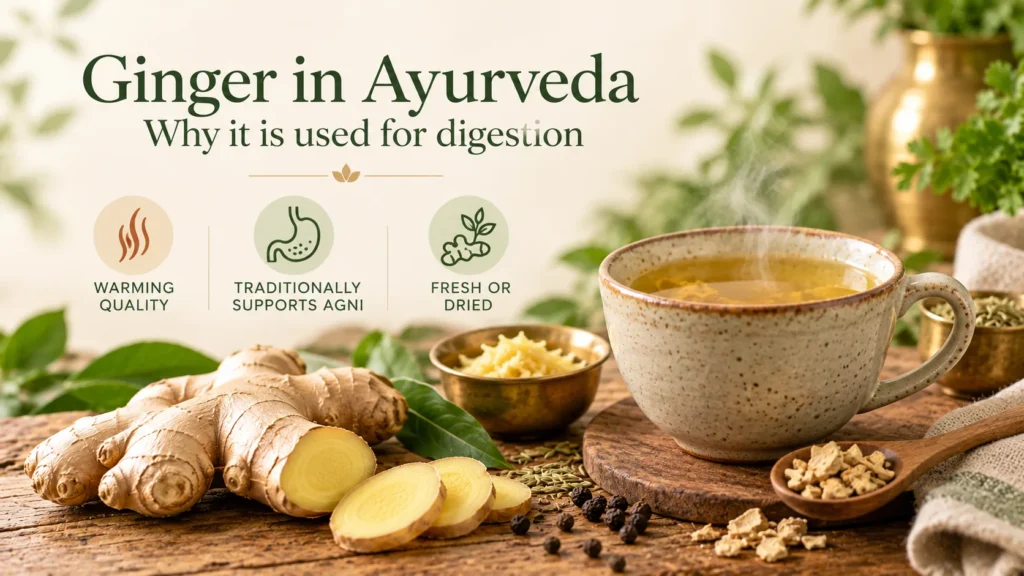
Ginger in Ayurveda has a long history as a warming culinary herb traditionally used to support digestion, encourage appetite and bring balance to Vata and Kapha.
Known botanically as Zingiber officinale, ginger is valued for its distinctive pungent taste and warming qualities. It can be used fresh, dried or powdered, with each preparation offering slightly different properties within Ayurvedic practice.
🌿 Why Ginger in Ayurveda Is Valued for Digestion
Ayurveda places considerable importance on Agni, the digestive fire responsible for transforming food.
Ginger is traditionally described as Deepana, meaning it kindles Agni, and Pachana, referring to its role in supporting the processing of food.
These qualities explain why ginger frequently appears in Ayurvedic meals, herbal preparations and warming drinks.
Its pungent taste and heating nature make it especially relevant when digestion is traditionally described as slow or sluggish.
The use of ginger in Ayurveda illustrates how herbs are selected according to their qualities, preparation and the person consuming them.
For a fuller explanation of Agni, read our Ayurvedic Principles Explained guide.
🔥 The Traditional Qualities of Ginger
Ayurveda evaluates herbs through several interconnected principles.
| Ayurvedic principle | Ginger’s traditional classification |
|---|---|
| Rasa – Taste | Katu – Pungent |
| Virya – Potency | Ushna – Heating |
| Vipaka – Post-digestive effect | Madhura – Sweet, particularly dried ginger |
| Dosha association | Traditionally balances Vata and Kapha |
These qualities help explain why ginger in Ayurveda is associated with warmth, digestive activity and reducing traditionally described Kapha heaviness.
Because ginger is heating, Ayurveda generally recommends moderation for people experiencing pronounced Pitta characteristics.
🥣 Fresh Ginger or Dried Ginger?
Ayurveda distinguishes between two preparations.
Fresh ginger (Ardraka) has a pungent, aromatic character and is commonly used in cooking, teas and freshly prepared meals.
Dried ginger (Shunthi) has a more concentrated flavour and is traditionally valued in warming herbal formulations.
Although both come from the same plant, drying changes their chemical composition and traditional classification.
This distinction is important when using ginger in Ayurveda, where preparation can influence how an ingredient is selected.
🧪 What Makes Ginger Interesting?
Ginger contains naturally occurring compounds called gingerols and shogaols, which contribute to its distinctive pungency.
These compounds have attracted scientific interest for their biological activity.
Human clinical research has also investigated ginger preparations for nausea.
A systematic review published in Nutrition Journal examined 12 randomised controlled trials involving 1,278 pregnant women. Researchers found that ginger improved nausea symptoms compared with placebo, although findings for vomiting were less conclusive.
This provides an interesting modern perspective on ginger’s long-standing association with digestive comfort. The studies examined specific preparations and populations rather than ordinary culinary portions.
🍵 Everyday Ways to Use Ginger in Ayurveda
Including ginger in Ayurveda-inspired meals is straightforward.
- Ginger tea: Simmer a few thin slices of fresh ginger in water for five to ten minutes.
- Vegetable soups: Add freshly grated ginger while cooking.
- Rice and lentils: Combine ginger with cumin and coriander for an aromatic meal.
- Warming stews: Add a small quantity of dried ginger alongside other spices.
Start with modest culinary amounts and adjust according to taste and comfort.
Ginger can aggravate heartburn in some people, and concentrated supplements warrant additional care, particularly during pregnancy or when taking medication that affects blood clotting.
🌱 Why Ginger Remains Important in Ayurvedic Cooking
The continued use of ginger in Ayurveda reflects its versatility as a warming spice and its traditional relationship with Agni.
Whether added to vegetables, lentils, soups or warming drinks, ginger brings flavour and a distinctive pungent quality to freshly prepared food.
Its place in Ayurvedic practice demonstrates an important principle: understanding an ingredient involves more than identifying its nutrients. Taste, preparation, traditional qualities and individual suitability all matter.
For everyday use, ginger offers a simple way to bring traditional Ayurvedic food principles into the kitchen.